5 signs your PPC contractor is just keeping the lights on
How to tell in 10 minutes whether your contractor is actually managing your Google Ads account or just keeping the campaigns running. Honest signals from real practice.
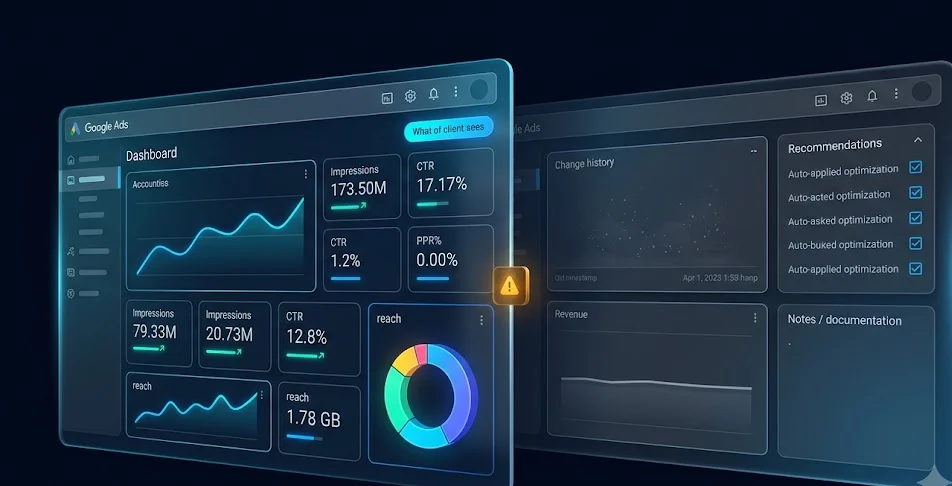
Most business owners tell me roughly the same thing: “I don’t get what my contractor actually does”. They log into Google Ads once a month, see a chart that looks like it’s going up, get a PDF report, and go back to running the business. And the revenue isn’t growing.
Sometimes that’s normal. Advertising doesn’t pay off in a week. Sometimes — it’s a signal that the person you’re paying $500-1,500 a month isn’t really doing anything. Just keeping the campaign switched on.
I’ll walk you through five signs I’ve seen in clients who came in for a second opinion. If you find two of them in yourself, it’s a reason to ask your contractor some uncomfortable questions. Three or more — time to talk about replacement.
Sign 1. Reports have no figures in money
Look at the last report your contractor sent. How many phrases include dollars, euros or hryvnia?
In a weak report it sounds like this: “CTR rose 18%”, “CPC dropped to $0.84”, “reach tripled”. Looks like work. There is work — but about the money that came back into the business, not a word.
An honest report reads differently. “Ad revenue: $14,720 against $3,400 in spend. ROAS 4.3x. Category A — $8,200 at ROAS 5.8x. Category B — $6,520 at ROAS 3.1x. Category C lost $400 — we recommend reallocating the budget, expecting +$2,500 of revenue over the next 30 days”.
The gap between those two reports is huge. The first says “we did something”. The second says “we worked on your business, here’s the result in money, here’s what we suggest next”.
If the contractor doesn’t write about money, one of two things is happening. Either revenue tracking isn’t set up — so they don’t even see whether ads pay off, and you’re flying blind. Or it is set up, but the numbers are bad and they’d rather not mention them. Either way — bad.
Sign 2. Change history is empty for weeks
This is the fastest check of all. Open Google Ads, find Change history through the top menu or Tools, set the filter to “last 30 days”. Look at how many changes there are.
A normal pace for active management is dozens of changes per week. New negatives, bid corrections, creative updates, headline tests, asset-group reworks, budget tweaks. That’s a specialist at work: they see something in the data and react.
If in 30 days there are 5-10 actions. Or only automatic system changes. Or nothing at all. That means “management” boils down to not switching the campaign off. Money is being spent, the algorithm decides things on its own, and the contractor pops in once a month just to check the campaign is still alive.
You can hyperactively tweak things that don’t need tweaking and cause damage. Performance Max especially hates frequent strategy or budget changes — every time, it re-enters the learning phase. But total silence in the history is not caution. It’s inaction. Look for the middle ground: systematic, justified edits a few times a week, not “nothing” and not “constant churn”.
Sign 3. To “why is revenue down” — the answer is “the algorithm is learning”
I’ve heard this phrase dozens of times from clients quoting their previous contractors. “The algorithm is learning, we have to wait”. “It’s the learning phase”. “Google is currently testing audiences, let’s not touch it”.
Sometimes that’s true. After significant changes Smart Bidding does need 7-14 days to recover. But “the algorithm is learning” as a universal answer to any deterioration is a red flag.
An honest contractor answers concretely when asked why ROAS dropped. Something like this: “ROAS fell from 4.1x to 2.8x in category X. We noticed it on Tuesday. We looked into it — turns out from the 1st the feed-signal structure changed and PMax started pouring more budget into a lower-margin sub-category. Already fixed it with custom labels, expect recovery in 5-7 days”.
That sounds like a medical diagnosis: symptom, cause, treatment, prognosis.
“The algorithm is learning” is not a diagnosis. It’s a way of dodging responsibility for the result. If the contractor doesn’t want to look at the cause, it means they don’t look at it at all, or they do but don’t want to discuss it with you.
Sign 4. The whole “optimisation” is Google’s recommendations
Google Ads has a Recommendations tab. The algorithm produces dozens of tips every day: expand the keyword list, raise the budget, add assets, switch to a different bid strategy.
Some of them are useful. Most aren’t. Many are actively harmful. Google suggests broader match types (so you spend more budget on irrelevant traffic), higher CPC (“to reach more impressions”), turning on auto-applied recommendations (so the system makes edits without your knowledge).
If you check the change history of your account and see that 80% of actions are “applied recommendation” from Google, it means the contractor effectively isn’t managing your advertising. They’re just clicking Apply on suggestions Google generates the same way for everyone. Algorithm work, dressed up as human work.
A strong contractor reviews Recommendations but applies a small fraction of them. And can explain why they applied these specific ones and rejected the others. If there’s no such selectivity, there’s no human in the process.
Sign 5. Zero documentation of what was done and when
Ask your contractor: what did you do with the account in March? In April?
If the answer is “well, we optimised, we looked at things” — or just silence — that’s a problem. Not because they should remember every step. But because a strong specialist always keeps documentation. Not for show — for the work.
With each client I keep a living document with the diagnosis of the starting state, a list of hypotheses we’re trying, dates of test launches, results, and conclusions. Without such a document it’s impossible to understand which changes caused which outcomes. Three months in without records, everything turns into “I think we tweaked something in the asset groups back then, or was it later…”.
Without documentation there’s no ability to draw conclusions. Which means there’s no ability to systematically improve the account. It all collapses into random actions with the hope that this time it works.
You can forgive a contractor for weak reports. You can forgive infrequent changes and find objective reasons. But if there’s no material at all about the history of your collaboration, it means one thing: you’re paying for work the contractor doesn’t even record for themselves.
If the contractor doesn’t write about money, doesn’t change the account for weeks, answers “the algorithm is learning” to any question, optimises via auto-recommendations, and keeps no records — they aren’t managing your advertising. They’re just keeping it switched on.
If you recognised one sign
It’s not a disaster yet. Go to the contractor with specific questions:
- How much revenue did the ads bring in last month?
- What are the three most important changes we made in the campaigns over the last quarter?
- What’s the plan for the next 60 days and which metrics specifically do we expect to improve?
If the answers are concrete and honest — fine. Maybe the problem isn’t the contractor but the communication. Ask if they could switch to a short weekly update — “this week we did X because we saw Y”.
If the answers are fog, excuses, or “well, the ads are running” — that’s already two signs.
If you recognised three or more
This isn’t a communication problem. It’s a competence or motivation problem. Because when someone takes $500-1,500 a month and over that time hasn’t written a single diagnosis, hasn’t made any serious change, and doesn’t record their own work, it’s either a beginner pretending to be a specialist, or a specialist for whom your account is passive income.
In both cases, you need an outside look. Either an audit — to understand what’s currently in the account and how much you can win back if nothing changes. Or a contractor change — with a mandatory transition plan so you don’t lose historical data and campaign learning.
If you’d like a look at your account
You don’t have to wait until the situation gets critical. Get in touch — on a free 15-minute call I can tell from the conversation whether your contractor is systematically working on the account, or just keeping it switched on. If a full audit is needed, I’ll tell you what’s in it, what it costs, and how fast we close it. If it isn’t needed — I’ll tell you honestly too.
Need help with advertising or analytics?
We will audit your account and show growth opportunities. The first assessment is free.
Discuss a project